
The New Smart-Home Upgrade |
Hint: It Isn't Another Screen — It's Water |
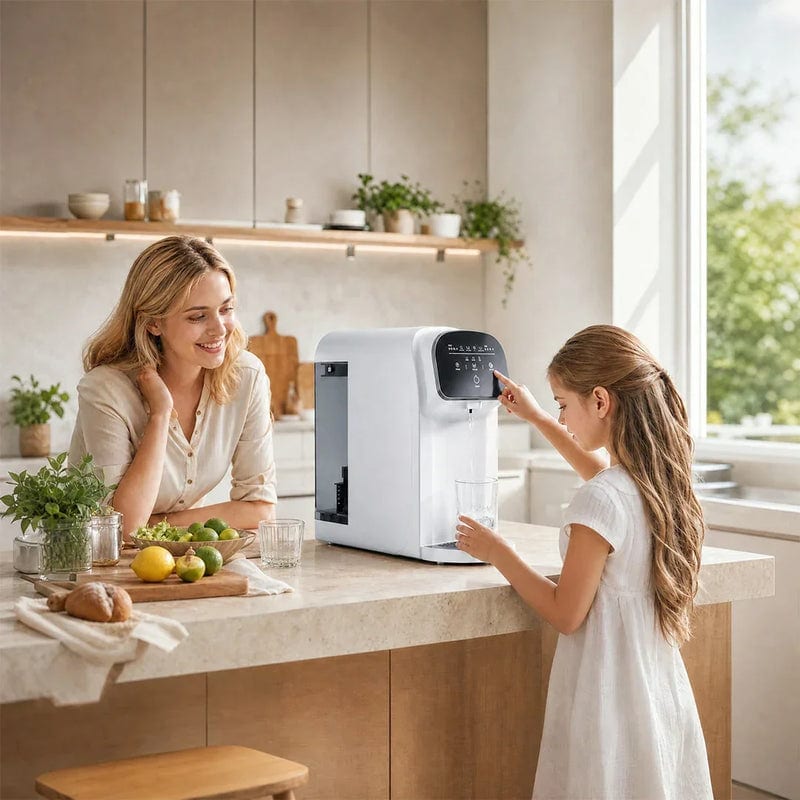
Walk through homes in Ballard, Green Lake, Wallingford, Greenwood, Northgate, Lake City, Shoreline or Edmonds and you'll find plenty of smart-home technology.
But some of the most useful home technology may ultimately be the technology that manages basic resources.
And that includes water.
Welcome to the Resource-Smart Home
The first generation of smart homes was largely about convenience.
The next generation should be about efficiency.
That's why homeowners may want to pay attention to developments in countertop water purification.
Aigerri's countertop reverse-osmosis system provides an interesting case study.
The company describes a plug-in system requiring no permanent plumbing installation, with multi-stage reverse-osmosis filtration, UV functionality, mineral enhancement and real-time water-quality monitoring.
Its stated pure-to-wastewater ratio is 5:1.
That means roughly five portions of purified water are produced for each portion discharged during filtration.
For homeowners researching RO systems, efficiency ratios like this deserve comparison alongside purchase price and filtration specifications.
But Don't Buy Technology Just Because It's "Smart"
Here's where WealthWire readers should be careful.
Technology companies are very good at selling features.
Homeowners need to evaluate outcomes.
Ask:
Those questions turn a gadget purchase into an informed household capital decision.
Bottled Water Is a Subscription You May Not Call a Subscription
Consider how we normally think about subscriptions.
Streaming. Software. Gym memberships. Cloud storage. But anything purchased repeatedly behaves economically like a subscription. If your household spends $30 every month buying bottled water, that's effectively a $360 annual water subscription. At $50 monthly, it's $600. At $75, it's $900. That's before considering the time and transportation required to keep purchasing it. A household filtration system changes the equation from repeated retail purchases toward owning equipment and replacing filters periodically. Whether that saves money depends entirely on the household. But it's worth doing the math. A Different Definition of Smart HomeThe smartest house may not ultimately be the house with the most connected devices. It may be the house that requires fewer outside resources to operate comfortably. A house that uses less energy. A house that wastes less water. A house capable of producing some food. A house that reduces unnecessary recurring expenses. A house designed for resilience. That's a far more interesting definition of "smart."
North End Nate's Wealth Move: Before buying your next smart-home gadget, identify one household resource you repeatedly purchase and ask whether technology can help you consume it more efficiently. |




0 Comments
Join the conversation
Be the first to comment
Share your thoughts above.